Align Farms
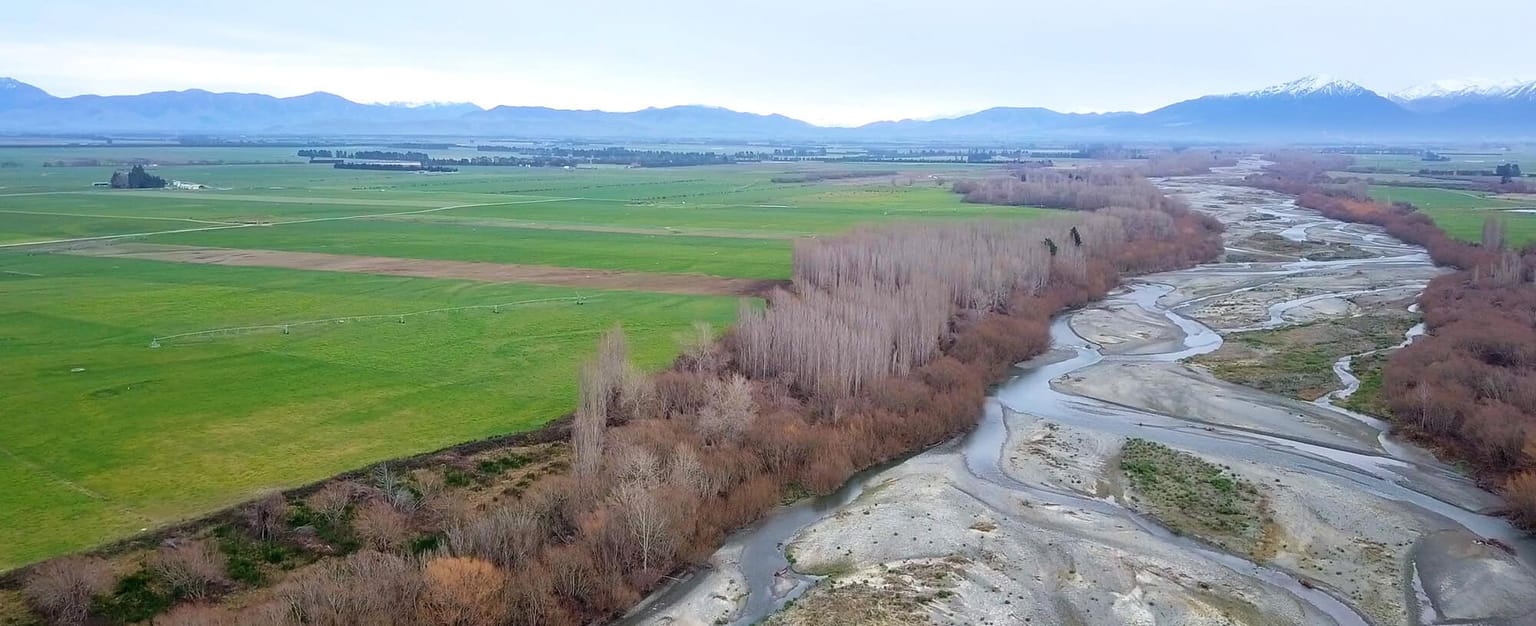
Canterbury, New Zealand
This story was filmed in 2020 and reflects one farmer’s own experience with their Tow and Fert. Every farm is different, so please treat it as a story rather than a forecast for your place.
Align Farms kept the same urea and changed how it goes on.
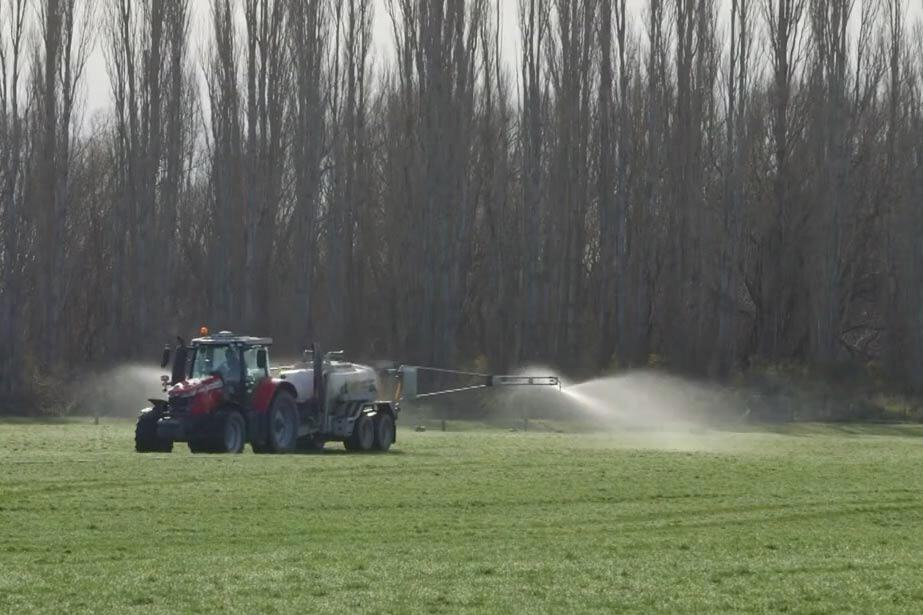
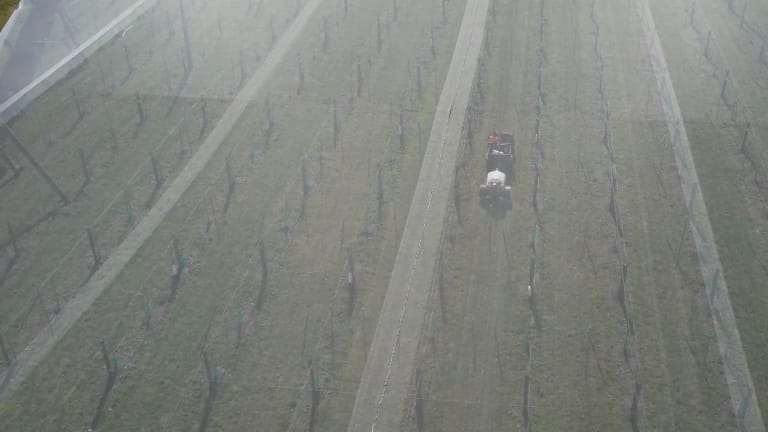
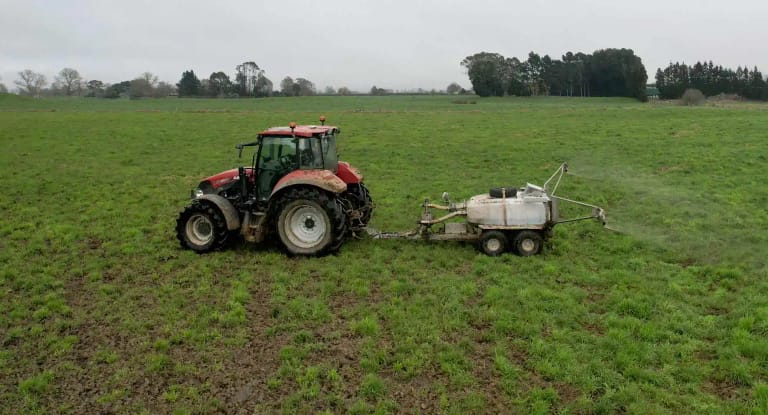
Align Farms runs five dairy farms and two support farms in Mid Canterbury. When the shareholders asked how the business could use less synthetic nitrogen, chief executive Rhys Roberts and his team started dissolving their urea and applying it paddock by paddock through the Tow and Fert system.
Rhys Roberts is chief executive of Align Farms. The group milks just under 5,000 cows across a couple of thousand hectares. Rhys calls it a fairly traditional Mid Canterbury system: some grain fed, cows wintered off on the group’s own support farms, and nearly everything grown in-house. We filmed with him at Align Clearview, near Westfield.
Where they started
The fertiliser programme was the conventional one. “We’ve always run a conventional fertiliser regime that’s been led by the major companies,” Rhys says, “putting on anywhere between 250 and 280 of N, and maintenance, optimising our N, P and K requirements, and an annual requirement of lime.”
Rhys looked at a few ways to bring the nitrogen down. “16 months ago, we were looking at it from: how do we start reducing our synthetic nitrogen use. And that come down from a shareholder perspective. And we looked at liquid N alternatives, Tow and Fert alternatives, just making a reduction in granular inputs.”
What swung it, he says, was being able to keep buying granular urea in its cheap, standard form and dissolve it in water or effluent from their own system. He also liked being able to treat each paddock on its own. “We quite liked the paddock by paddock solution, rather than having a broad acre N application.”
The first season
Rhys set the business a target for the first year. “Leading into Christmas, January time, we were on target to cut about 200 tonne of synthetic nitrogen out of our business,” he says. “Just due to warmer conditions in May, we ended up doing three weeks extra of N application. So we made a reduction of 160 tonne of urea. Generally our business puts on about 500 tonne of urea, so we’ve made about a 30 to 33% reduction in nitrogen use this year.”
Rhys says whatever they saved on nitrogen went back into the rest of the programme: phosphate, potassium and lime, and trace elements in the brew, mainly selenium.
Then there was the question every dairy farmer asks. “The key question was, was there a drop in productivity on our farms? And our short answer is no. We didn’t see any fundamental shifts,” Rhys says. “With all dairy farmers, we understand that it’s always a hard calculation to work out your pasture production. Our back calculations are showing us that we grew as much, if not more, grass this year.”
“Was it a one-off or can we do it again? I’m confident that we can do it again. Whereas 12 months ago, if you’d said to me that we were going to drop 30% of N, I probably would have laughed at you.”
How Rhys sees it
“My take on where legislation and the 190 caps are: as New Zealanders, we do pay for our sins eventually,” Rhys says. “And potentially, my view is we need to take step changes and continue to make step changes.”
The urea itself hasn’t changed. “My view is we’ve got to get more efficient around how we utilise our nitrogen in our systems. And one area that I find does work well is you are still taking just a granular, off the shelf urea product and mixing it with water and using less of it.”
“To me it’s a bit of a no-brainer really, because you’re still getting the efficiency of just a core commoditised product, mixing it with water and applying it to your pasture. There’s savings to be made there. So not only are we in line with where legislation and restrictions are going, we’re also making a cash saving to our business and being efficient along those lines.”
So for me, it’s moved out of the too hard basket into the bit of a no-brainer basket.
Thinking about Tow and Fert?
Talk with a specialist
Tell us about your operation and we’ll match the right model and setup for you.
Rhys also rates round length as a way to use less nitrogen, and that one doesn’t need a machine. Where he sees foliar fitting in is timing. “One of the challenges that we’ve got with the granular system is, let’s say you are on a 23 day round, it might take you four days to get in the paddock, and then another four days to break down. You’ve lost eight days.”
“One of the beauties with a product that’s in suspension or through the Tow and Fert system is that you’re getting uptake into the plant on day one, and then you’ve got growth there going forward. So you’re maximising that pasture production, which is a critical opportunity on a dairy farm.”
A year on
Rhys was the one who needed convincing, and he says so. “If I put myself back 18 months ago, I was pretty sceptical about making the reduction, personally. I thought moving from 250 down to 160, 180 was probably going to be a relatively big push for us. We now find ourselves 12 months later, we’ve achieved that. We’ve got under 180 units across the business.”
“We haven’t seen any material changes in pasture production … or milk production for that matter. So we’re relatively comfortable with the system. We find the Tow and Fert system versatile, pragmatic, does everything that we need.”
He wants a few more seasons before he calls it. “We just continue to do another two or three years of what we’re doing at the moment, making sure that it continues to do what we’re doing. We just didn’t strike a one-off season.”
My advice to most farmers is, doing nothing won’t do anything. So let’s make a change.
Rhys Roberts, chief executive, Align Farms
Sam Mallard, farm manager, Align Emilius
Same urea, dissolved in the machine.
Sam manages Align Emilius: 173 hectares effective, 782 cows, supplying Synlait. “As a company, [Align] likes to pre-empt change, I suppose, be ahead of the curve,” he says. “So we had a feeling that something in this space was going to arise, and we saw a prime opportunity to reduce the amount of nitrogen that we were using by going over to a Tow and Fert system.”
Nothing changed in the bag. “We actually haven’t changed the product, so we’re still using urea as such. But it was a granular prill which we were spreading on the paddock previously, which now gets dissolved in the machine.”
We’re targeting the nitrogen to be uptaken by the plant in its leaf, rather than throwing it onto the soil and hoping for the best.
Sam Mallard
Sam’s figures are for Emilius on its own, one season against the next. “Last season we sat around the 240 units of nitrogen a hectare, and this season we’ve gone down to around 180 units of nitrogen a hectare, which puts us already under the cap of the 190 a hectare that they’re asking us for.”
“I remember at the beginning of the season, Rhys phoning me up, asking me whether we thought there was more or less grass being grown by the Tow and Fert,” Sam says. “From the beginning we knew that it was definitely growing the same, if not more grass, than we’d done in history. It definitely wasn’t less. So we did about 1860 milk solids last season, and this year we pulled out about 1926, from memory, with less nitrogen used. So that’s a brilliant result for us.”
He isn’t finished with it. “Now we’ve got to look at how far we can push the boundaries of this and continue dropping that nitrogen rate, still using the Tow and Fert system, to find out where the equilibrium really sits.”
And his advice to other farmers: “My advice to other farmers thinking or looking at using the Tow and Fert system is, it’s a very good solution to dropping under the 190 units, which we’re now being asked to do …”